Sunday, 6 November 2016

semester 3 art and aesthetic

Carnatic music, Karnāṭaka saṃgīta or Karnāṭaka saṅgītam is a system of music commonly associated with the southern India including the modern states Andhra Pradesh, Telangana, Karnataka, Kerala, and Tamil Nadu, but also practiced in Sri Lanka.[1][2] It is one of two main subgenres of Indian classical music that evolved from ancient Hindu traditions, the other subgenre being Hindustani music, which emerged as a distinct form because of Persian and Islamic influences in northern India. The main emphasis in Carnatic music is on vocal music; most compositions are written to be sung, and even when played on instruments, they are meant to be performed in gāyaki (singing) style.
Although there are stylistic differences, the basic elements of śruti (the relative musical pitch), swara (the musical sound of a single note), rāga (the mode or melodic formulæ), and tala (the rhythmic cycles) form the foundation of improvisation and composition in both Carnatic and Hindustani music. Although improvisation plays an important role, Carnatic music is mainly sung through compositions, especially the kriti (or kirtanam) – a form developed between the 14th and 20th centuries by composers such as Purandara Dasa and the Trinity of Carnatic music. Carnatic music is also usually taught and learned through compositions.

2.LIGHT MUSIC 
Light Music bridges the gap between classical and popular music, although its boundaries are often blurred.1 It is music with an immediate appeal, music to entertain and to enjoy. It has a strong emphasis on melody,2 and as such, it is designed to appeal to a wider audience than more serious forms of the Western classical music tradition.
As the length and scope of orchestral music increased in the late Romantic period of classical music history (between 1850 to 1900), the Light Music genre emerged as a more accessible and enjoyable, less highbrow and less elitest alternative. Works in the genre include:
  • the operettas of Gilbert & Sullivan and Offenbach,
  • the waltzes and marches of Johann Strauss II and his family,
  • the marches of J.P.Sousa,
  • tuneful orchestral music by composers such as Eric Coates, Leroy Anderson, Ernest Tomlinson and Robert Farnon.
Palm court music, symphonic jazz, ballet music, show music, arrangements of popular songs and ballads, film music and television themes are all part of the Light Music repertoire.

Image result for light music

                3.PATRIOTIC SONG
                                This happens on and around days like the independence and republic day, and I feel very touched when I listen to patriotic songs. I feel moved with realizations of so many precious sacrifices of life to bring my country to a state of freedom. Sometimes they bring me to tears too! I am otherwise not very patriotic but I really like patriotic music about celebration of the current diversity and independence.Image result for PATRIOTIC SONG

                    4.FOLK MUSIC

                                  can refer to both traditional types of music and the modernnotion of folk music that arose during the 1960s in the United States. Traditional folk music has been around as long as music itself, but the term “folk music" wasn't really used until the 1800s.Image result for folk music

Traditional fold music— sometimes called world music — can be hard to define, but there are several common characteristics that help define the genre. Traditional folk music can usually be thought of as old music by unknown composers that has been passed along orally for generations by the poor, working class.
  5.MAPPILA SONG 
            Mappila Paattu or Mappila Song is a folklore Muslim song genre rendered to lyrics in colloquial Mappila dialect of Malayalam laced with Arabic, by the Mappilas of Malabar.[1] Mappila songs have a distinct cultural identity, while at the same time, remain closely linked to the cultural practices of Kerala. The songs often used words from Persia, Urdu, Tamil, Hindi apart from Arabic and Malayalam, but the grammatical syntax was always based on Malayalam.[2][3] They deal with themes such as religion, love, satire and heroism, and are often sung at occasions of birth, marriage and death. Mappila Paattu form an integral part of the heritage of Malayalam literature today and is regarded by some as the most popular branch of Malayalam literature, enjoyed by all communities in Kerala.
 6.BHARATHANATYAM
Image result for bharatanatyam dance
            Bharatanatyam or Bharathanatiyam is a major genre of Indian classical dance that originated in the Hindu temples of Tamil Nadu and neighboring regions.[1][2][3] Traditionally, Bharatanatyam has been a solo dance that was performed exclusively by women,[4][5] and expressed Hindu religious themes and spiritual ideas, particularly of Shaivism, but also of Vaishnavism and Shaktism.[1][6][7]
Bharatanatyam's theoretical foundations trace to the ancient Sanskrit text Natya Shastra,[6] its existence by 2nd century CE is noted in the ancient Tamil epic Silappatikaram, while temple sculptures of 6th to 9th century CE suggest it was a well refined performance art by mid 1st millennium CE.[5][8] Bharatanatyam is quite possibly the oldest classical dance tradition of India.[9]
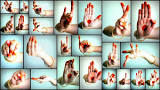
Bharatanatyam style is noted for its fixed upper torso, legs bent or knees flexed out combined with spectacular footwork, a sophisticated vocabulary of sign language based on gestures of hands, eyes and face muscles.[8] The dance is accompanied by music and a singer, and typically her guru is present as the director and conductor of the performance
    MUDRAS OF BHARATHANATYAM
           

   8.MOHINIYATTAM

                    Mohiniyattam is a dance form said to have originated in Kerala. It is closely related to Bharathanatyam of Tamil Nadu, 

Mohiniyattamwhich was originally called 'Dasiyattam'. Originated as the temple dance performed by Devadasis, it portrays feminine love in its myriad forms - carnal, devotional and maternal- with accent more on Lasya and Bhava. In the main items Cholkettu, Padavarnam and Padam, Mudras and facial expressions are more important than the rhythmic steps. Costumes and ornaments of Mohiniyattam have much in common with female characters of Koodiyattam and Kathakali.

Once Mohiniyattam was performed only in Temples premises and royal courts. The first reference to Mohiniyattam is found in 'Vyavaharamala' composed by Mazhamangalam Narayanan Namboodiri, of 16th century AD. Major contributions to this art form were given by Maharaja Swathi Thirunal, Irayimman Thampi and Kuttikunju Thankachi.       


semester 2 book reflection

                   READING AND REFLECTION  OF BOOKS
     
BOOK-1
     
       WOMEN AND SOCIAL REFORM IN MODERN INDIA  
                             
                                                                  -Dr.Pramjitkaur J  Walia
                                          In modern times women play very important roles in education, trade, buiness,commerce,politics,social work,and justice.indian women are also participatingin each and every aspects of our society.Our government has made changes in our constitution to provide reservation in panchayat elections and also gave reservation to women in state and central government made act for anti-harassment to women and also made provision of punishment for evaders of this law.

BOOK -2
      THE POLITICS OF INDIA SINCE INDEPENDENCE
                                                                  -Paul R Brass
                                          India arrived at independence after a long struggle and with a multiplicity or heritages and legacies which influenced its post -independence course in complex ways.Among the legacieswere the long experience of british rule itself ,which extended back more than two countries,and of the various institutions,ideas,and practices,introduced by the british.

Thursday, 3 November 2016

semester 1 discussio and demonstration

DEMONSTRATION 

TOPIC : TSUNAMI 
 Name of the teacher : Shiji 


TOPIC : Social groups 
Name of the teacher : Ancy .L 


TOPIC :Social control 
Name of the teacher :  Sabitha .y 
 Name of the teacher : Soumya R.S 


Monday, 24 October 2016

semester 3 Record of school internship phase -1

 RECORD OF SCHOOL INTERNSHIP PHASE-1


                                 SEMESTER -3
     CONTENTS
     
  1. INDUS VALLY CIVILIZATION
  2. DECLAINE OF INDUS VALLY CIVILIZATION
  3. EGYPTION CIVILIZATION
  4. MESOPOTAMIA CIVILIZATION
  5. CHINEES CIVILIZATION
  6. LAYERS OF EARTH
  7. ROCKS
  8. WEATHERING
  9. FUNDAMENTAL RIGHTS 
  10. PIGHT TO EQUALITY 
  11. CULTURAL AND EDUCATIONAL RIGHTS
  12. EARTH QUAKE
  13. FUNDAMENTAL DUTIES
  14. DIRECTIVE PRINCIPLE OF STATE POLICY
  15. HEAT BUGET
  16. FLEAD
  17. HEAT TRANSFOR IN THE ATMOSPHERE
  18. ORIGIN OF SOIL 
  19. DESTRISION OF SOIL
  20. DUTIES OF PRIME MINISTER
  21. PRESIDENT
  22. INDIAN GOVERNMENT
  23. JUDICIARY SYSTEM
  24. UNION COUNCIL OF MINISTERS
  25. NATIONAL INCOME
  26. VISE PRESIDENT
  27. DUTIES OF PRESIDENT
  28. AREBIAN EMPAIRE
  29. VOULCAINES
  30. CLOUDS
  31. MEDIEVAL AMERICAN
  32. DECLAINE OF FUEDALISM
  33. TYPE OF SOIL 
  34. RIGHT TO FREEDOM
  35. RIGHT TO FREEDOM OF EDUCATION
  36. INDIAN JUDICIARY SYSTEM
  37. ICT LESSON TEMPLATE 
  38. ADVANCE ORGANISED MODEL
  39. CONCEPT ATTAINMENT MODEL
  40. JUDISPRIDENTIAL INQUARY MODEL

Sunday, 28 August 2016

semester 3 book reflection

                   
    READING AND REFLECTION OF BOOKS 

BOOK -1
           THE PRIME MINISTERS OF INDIA 
                                                 -Dr.R.K.Pruthi
                                                 A Prime minister is the chief member of the cabinet in a paliamentary system of government,or alternatively an official in a presidential system or semi-presidential system.His duty is to execute the directive of the president and manage the civil service. Prime ministers can be found in both constitutional monarchies and in republics,where the head of state is an elected or unelected official with varying degrees of real power.

BOOK -2
                 INDIAN FREEDOM MOVEMENT AND STATES
                                                -Santosh kaul
                                 The british empire in india ended on August 14,1947.With it,came to its close the british paramountcy,which symbolished the british authority over the states.The british, the muslim league and the Indian National Congress had,in their own way,opposed the inclusion of the states in the constitutional reforms ,the Indian National Movement epoused .The british held the indian states as a personal preserve,protected the princes against their people and governed them to serve the interests of their empire in india. 

Friday, 27 May 2016

SEMESTER 2 STUDY TOUR

                      STUDY TOUR

PLACE

v Rameswaram


v   Kodaikanal
   INTRODUCTION
                     We the B.Ed students got a golden oppertunity to visit Rameshwaram and Kodaikanal.We forgot our bury college day and enjoyed our level best.It was a two day trip from 5.5.2016 to 8.5.2016.Our teachers and friends enjoyed the trip very much.We 24 students and 6 teachers were attended the trip.I forgot my all tensions and enjoyed the trip.It was an everlasting memory to all of us.Away from home and everyday life we have the oppertunity to be inspired try out new thing,learn and aquire experience and new interested in a new exiting environment but also to rest and take a welcomes.

OBJECTIVES
  • To impart knowledge about eco-friendly life.So that the students aquire the skill of live in perfect harmony with nature.
  • To improve the students happiness through their mind.
  • To gain the clear idea the natural resource.
  • To get a refreshment and enjoyment from bury college life.

TRIP AT A GLANCE

              Study tour enhances intellectual and enjoyment happiness to the students .It is both pleasurable and information seeking one.Our study tour was a happiest one .There were 24 students,6 teaching staffs and one non teaching staff.

5.5.2016
Thursday

              We started our journey at 9:30 p.m.In our tourist bus ,so many students wew started to dancing and whisting.I am egarlly happy to see their enjoyment .For the students necessary needs like first aid things and students drinking water etc were previously packed and Rajesh sir assigned some students for its duty.We saw different shops,beautiful house rivers streams,temples,mosques etc on the way.We saw a film "Vellaram kannulla vellimoonga".That time some students stept in the bus.

6.5.2016
Friday

           At 6.00 a.m we reached Rameshwaram were I saw so many other tourists.Then we got some time for become fresh.Then at 9.00a.m we went to Rameshwaram Shiva Temple in to two mini buses.The temple is known as "Rameshwaram temple" is a hindu temple decided to the God Shiva located on Rameshwaram Island in the state of Tamil Nadu.Many of the students were entered in to the temple and visited .But three or four students were stand out side temple.


7.5.2016
Saturday 


          Our bus began to run high range in early morning.It felt my head round when the bus circle in the high rangr road.We reached the kodaikanal lake at 9:30 a.m. Kodaikanal lake is also known as Kodai lake is a manmode lake located in the lake is said to ne Kodaikanal most popular geographic land mark and tourist attraction.

Rameswaram
Ramanathaswamy Temple 
Ramanathaswamy Temple is a Hindu Temple dedicated to the god Shiva located on Rameswaram island in the state of Tamil Nadu, India. It is also one of the twelve Jyotirlinga temples.It is one of the 274 Paadal Petra Sthalams, where the three of the most revered Nayanars (Saivite saints),  Appar,  Sundarar and  Tirugnana Sambandar,  have glorified the temple with their songs. The temple was expanded during the 12th century by Pandya Dynasty, and its principal shrines sanctum were renovated by Jeyaveera Cinkaiariyan and his successor Gunaveera Cinkaiariyan of the Jaffna kingdom. The temple has the longest corridor among all Hindu temples in India.[1] The temple is located in Rameswaram considered a holy pilgrimage site for Shaivites,  Vaishnavites and Smarthas. The presiding deity, the Lingam of Ramanathaswamy (Shiva), is believed to have been established and worshiped by Rama, an avatar of the god Vishnu, to absolve the sins created during the Ramayana war at Sri Lanka


Rameswaram Beach
However Rameswaram Island is covered with sea on all of its sides, Sea Shores available on all of its corners , all them are not sandy, pebbly Beaches. The list of the Beaches in Rameswaram is given below. Click on the corresponding images to know more about them Every day thousands of pilgrims took bath in these holy seas. These spots also serves as a tourist attraction in Rameswaram. Holistic rituals such as prohithams, yangnya(yaham), tharpanam (ritual for the ancestorswho were dead) has been performed in the shores of Agni theertham.Dhanushkodi beach extends upto 15 Km long. The shore in the place called mukundharayar chathram is safest region for taking baths and playing in the high tide sea. since the tides of the sea is very high (maximum height registered as 12 feet) it is not suitable for the persons who don’t know swimming. The beach bike ride in this sea shore is ecstatic experience.

Rameshwaram Ramar Patham
This is a small hillock which has got the divine feet of lord Rama.it is also said the hangman crossed the sea from here only to srilanka.he used this hillock to jump to Lanka as this the highest point in rameswaram in the olden days,
One pujari is here for only collecting money but not explaining anything to any visitors.


Abdul Kalams House
Located favorably on Mosque Street, the Former President A.P.J. Abdul Kalam House is an interesting place to visit. Dr. Avul Pakir Jainulabdeen Abdul Kalam is a renowned scientist and writer, who was born and brought up in the town of Rameswaram. At present, his residence has been converted into a museum that stocks his childhood memoirs. The place is ideal to get a glimpse into the extraordinary life of this simple man, right from childhood to his research days. Several pictures and awards of Dr. Kalam are kept on display in this two-storey building, which is maintained by his elder brother. Moreover, a section of the house has been turned into a store that sells a variety of merchandise.


Rameswaram Floating Stones

            Here is a small temple known as PanchMukhi Hanuman...quiet close to the Rameshwaram Bus Station . This is just like any another Lord Hanuman Temple except that you will find the floating stone ...which was used by 'Nal - Neil ' to build the stone bridge to Sri Lanka ... Initially when I saw this ...I thought it to be a huge Wood Log ..And I was really damn sure..as I was not allowed to touch the same ....but there was another such stone which the temple priest allowed me to touch ...It was a real hard rock ..and it was floating on the water .( there was a drum full of water ) ..on which these two big , sized roughly around 10kg each stone were floating ..I touched that and pushed it down...And it came back ...The stone indeed looked very  old . No Doubt the Civil Engineers were really smart than today’s. True as per the Legends these were the stone using which Rama crossed the Deep Sea to invade Lanka to free her wife ...and to kill the Demon Ravana


Pamban Bridge 
                Pamban Bridge is a railway bridge which connects the town of Rameswaram on Pamban Island to mainland India. Opened on 24 February 1914, it was India's first sea bridge, and was the longest sea bridge in India until the opening of the Bandra-Worli Sea Link in 2010. The rail bridge is, for the most part, a conventional bridge resting on concrete piers, but has a double-leaf bascule section midway, which can be raised to let ships and barges pass through.


Meenakshi Amman Temple 
Meenakshi Amman Temple is a historic Hindu temple located on the southern bank of the Vaigai River in the temple city of Madurai, Tamil Nadu, India. It is dedicated to Parvati, known as Meenakshi, and her consort, Shiva, here named Sundareswarar.[4] The temple forms the heart and lifeline of the 2,500-year-old city of Madurai and is a significant symbol for the Tamil people, mentioned since antiquity in Tamil literature. Though most of the present structure was built between 1623 and 1655 CE.[6][7][8] It is said that the temple was originally built in the 6th century BC by survivors of the Kumari Kandam. In the 14th century, the Sultanate Muslim Commander Malik Kafur plundered the temple and looted it of its valuables. It was rebuilt by the Nayak ruler Vishwanatha Nayakar around the 16th century. It was Vishwanatha Nayaka who rebuilt the temple in accordance to shilpa shastra. It houses 14 gopurams (gateway towers), ranging from 45–50m in height. The tallest is the southern tower, 51.9 metres (170 ft) high, and two golden sculptured vimanas, the shrines over the garbhagrihas (sanctums) of the main deities. The temple attracts 15,000 visitors a day, around 25,000 on Fridays,[9] and receives an annual revenue of ₹ 60 million. There are an estimated 33,000 sculptures in the temple. It was on the list of top 30 nominees for the "New Seven Wonders of the World". The temple is the most prominent landmark and most visited tourist attraction in the city. The annual 10-day Meenakshi Tirukalyanam festival, celebrated during April and May, attracts 1 million visitors.


Kodaikanal

Kodaikanal Lake
Kodaikanal Lake, also known as Kodai Lake is a manmade lake located in the Kodaikanal city in Dindigul district in Tamil Nadu, India. Sir Vere Henry Levinge, the then Collector of Madurai, was instrumental in creating the lake in 1863, amidst the Kodaikanal town which was developed by the British and early missionaries from USA. The lake is said to be Kodaikanal's most popular geographic landmark and tourist attraction. Over the years a boat club, boathouse and boat service (with rowing boats and pedalling boats and a public ferry) for the public and tourists has become fully functional and is of aesthetic significance for tourism. Boat Pageant and Flower Shows are a regular feature in the summer season which attracts tourists.

kodaikanal la saleth church
La Saleth is one of the oldest churches of the state of Tamil Nadu. This is one of the two churches dedicated to the memory of Lady of La Saleth in the whole world, the other one is in France. La Saleth Church is located in Kodaikanal district of Tamil Nadu and is distinct than other churches in the region in many ways. It is just two kilometers from Kodaikanal bus stop. La Saleth is only church in India that commemorates the memory of ‘Lady of La Saleth’ and also the first one built in the memory of Mother Saleth. La Saleth Church is more than 130 years old and is one of the most popular churches in Kodaikanal. The church was built by Father Saint Cheer in 1866 after an interesting incident in his life. The Father suffered from severe illness and persistent fever in 1958. When all medications failed, he turned to faith and prayed to Lady of La Saleth. He recovered miraculously in no time. This incident led to the decision to build a church in memory of Mother Saleth.

Pillar Rocks
Pillar Rocks, 8 kilometres (5.0 mi) from the bus-stand, is a set of three giant rock pillars which stand 122 metres (400 ft) high. Managed by the Tamil Nadu Forest Department, The viewpoint can be crowded but is not commercialized. There is an excellent public garden adjacent to the viewpoint.
Pine forests, In 1906, with a view to growing valuable timber, Mr. Bryant started the Kodaikanal pine plantations in the south-west of Kodaikanal.


Green Valley
Green Valley View is place from which you can get an amazing view of the plains from Kodaikanal. This view point, erstwhile known as "Suicide Point" has been renamed presently as "Green Valley View". This place is situated near the Kodaikanal Golf Club and on the way to the Pillar Rocks. Standing in this point, you get an bird's eyeview of the 5000 ft deep valley with all the flora and fauna and the Vaigai Dam, to some extent. But, the views solely depend on your luck and time, as this place gets misty too often. If there is mist also, you may wait for sometime and it gets cleared and the views from here are amazing.